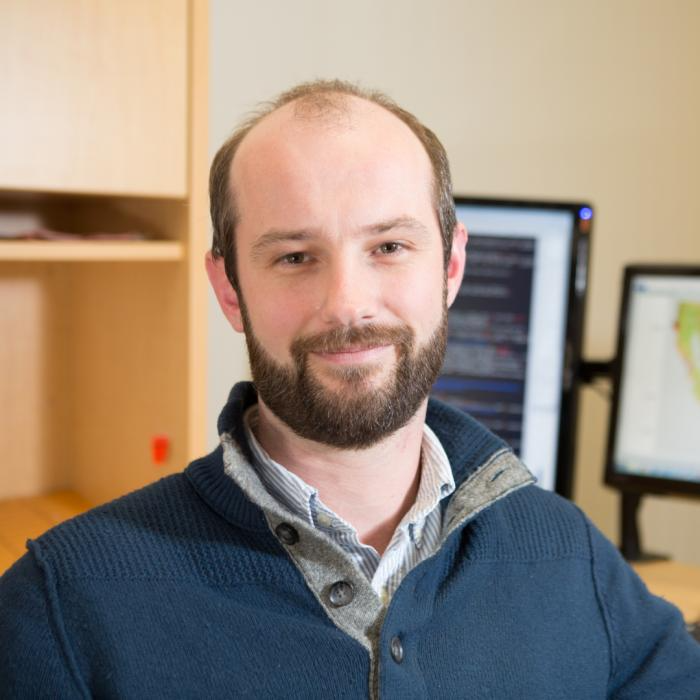
Michael L. Mann Geography · GWU
Associate Professor · Director of Graduate Studies

Spatial modeling at the intersection of :
remote sensing,
machine learning,
human systems.

I build end-to-end geospatial data science pipelines — combining satellite imagery, spatial econometrics, and machine learning to forecast wildfires, predict crop loss, and monitor welfare in data-sparse regions across the Global South.

Michael L. Mann
2,142
Citations · Scholar
134
Repos · GitHub
447
GitHub
GWU
Geography · DGS

01About

I'm an Associate Professor in the Department of Geography & Environment at The George Washington University, where I also serve as Director of Graduate Studies. My work sits at the intersection of remote sensing, machine learning, and geospatial modeling — with applications ranging from fire probability in California to crop-loss prediction, mapping urban deprivation, and monitoring household welfare in data-sparse environments across the Global South.

Alongside research, I lead or co-lead two Python packages that have become widely used in the geospatial community: GeoWombat, which simplifies large-scale remote sensing workflows, and xr_fresh, which automates time-series feature extraction from gridded data. I'm also the lead author of pyGIS.io, a freely available online textbook that has become a common reference for geospatial programming in both academic and professional settings.

I've served as a consultant to the World Bank, the U.S. Department of Treasury, and private geospatial firms — building end-to-end pipelines that combine satellite imagery, spatial econometrics, and machine learning. My work has been supported by USAID, Meta, and the National Science Foundation, and published across PNAS, PLOS ONE, Climatic Change, Ecological Economics, and Remote Sensing.

Cumulative citations
2,142 by 2026
Source: Google Scholar · updated Jan 2026
h-index22
i10-index25
Since 20201,417 cites

Highlighted

First or second author · peer-reviewed

03Code & open source

All 134 repositories on GitHub →

04Teaching

GWU Geography & Environment →
GEOG 3106

Intermediate Geographic Information Systems

Second course in the GIS sequence — spatial analysis, geoprocessing workflows, and cartographic design. Lab-based with real policy and environmental datasets.

GEOG 6293

Programming for Geospatial Applications

Python for geospatial analysts — scripting, automation, and data pipelines. Foundations of GeoPandas, rasterio, and xarray for reproducible spatial work.

GEOG 6306

Geographic Information Systems II

Graduate GIS with Python — advanced spatial data structures, scripting, and reproducible analysis workflows. Final project is student-designed.

GEOG 6293

Open Source: Geo-Programming II

Advanced open-source geospatial programming. Large-scale remote sensing workflows, time-series feature extraction, and machine learning with GeoWombat and xr_fresh.

05Consulting with pyGIS™

Over 15 years of consulting with public-sector agencies and private geospatial firms — building end-to-end pipelines that combine satellite imagery, spatial econometrics, and machine learning. Engagements typically span scoping, data architecture, model development, and delivery of reproducible workflows to client teams.

Recent work has covered crop-loss forecasting, urban deprivation mapping, electricity reliability from night-lights, and agricultural productivity in data-sparse regions.

Request for service: Please fill out this form

The World Bank
Crop modeling · Welfare mapping
U.S. Treasury
Geospatial data strategy
USAID
Funded PI
Meta
Funded research
IFPRI
Agricultural analytics
NSF
Interdisciplinary PI

06News & talks

Apr 2026
Talk
Invited session organizer, AAAS Annual Meeting — geospatial AI for sustainability.
Mar 2026
Release
pytidycensus v0.1 released — tidy Python interface for U.S. Census APIs.
Nov 2025
Paper
GeoWombat preprint posted on ESS Open Archive — "Remote Sensing with a Strong Backend".
Sep 2025
Teaching
New semester of GIS II kicks off. Syllabus now uses pyGIS.io as primary text.
Feb 2025
Field
YouthMappers Cesium Ecosystem Grant work coming together — early 3D-tile workflows.

07Contact

Get in touch

Michael L. Mann
Associate Professor of Geography
The George Washington University
Washington, D.C.
Email

Elsewhere